
LSAT x AI: Part I
Using ChatGPT to Develop a Study Plan
I recently took the August 2025 LSAT and used ChatGPT as a studying tool.
Going into the exam, I had two key constraints: time and money. Time, because I work a full-time job, play competitive volleyball, and have a fulfilling social life that I prefer not to compromise. Money, because I am one year post-grad and committed to being financially independent.
After receiving an underwhelming score on my June 2025 LSAT, I knew that I needed to upgrade my study plan – but had no idea how to do it. My partner suggested that I use ChatGPT. To be honest – despite all my thinking and writing on “the intersection of AI and critical thinking,” studying for the August LSAT was the first time I meaningfully relied on AI tools. So, I wanted to document this experience.
During my studying, I used ChatGPT for two distinct purposes: (1) Developing a study plan (using ChatGPT to develop a specific work product) and (2) Drilling logical reasoning question types that I struggled with (using ChatGPT as a study companion). I am publishing my reflections in two parts, with the first part, below, centered on my experience building a study plan with the AI tool.
Part I: Using ChatGPT to Develop a Study Plan
The Context
I was at a low. It had been hours since I received an LSAT score below what I had wanted. I felt dumb and incompetent, and above all, lost.
I knew that I didn’t have the most optimal study schedule. I first started studying on March 1, 2025 (I gave myself until then to acclimate to post-grad life). At the time, I was juggling working a full-time job, working a part-time job (coaching), and playing volleyball 2-3 times a week. Plus, a relationship and close friendships. I didn’t have a lot of time to study, but I did the best that I could – I woke up early to squeeze in an hour or an hour and a half before work. I went to the library and cafes to study after work. If I had volleyball and I couldn’t get home until 10:30 pm, I committed to working for at least an hour before sleeping. If I was coaching at an away tournament, I would fulfill my coaching responsibilities in the morning from 6am to 3pm, and then spend the time until dinner holed up in my hotel room. These away tournament days were generally my practice test days – a two-and-a-half-hour time block at a reasonable hour of the day, where I had an air-conditioned room to myself. Perfect testing conditions (less the fact that I was generally running on five hours or sleep or less and was exhausted from standing all day).
From March to my June LSAT, I sacrificed a lot of sleep and “me time,” hoping that my effort would translate into effectiveness. My score suggested to me that it didn’t. Afterwards, I felt at a loss. I didn’t want to give up my life, but I knew that something needed to change. I was complaining to my partner, and he, ever-AI-friendly, suggested that I turn to ChatGPT – specifically, that I ask it to create a more “sustainable study schedule.” That suggestion gave me some pause. For all my optimism about AI, the truth is that I am hesitant to use it myself. I’m scared of it crowding out my own thought process. But in a fit of desperation, I gave it a try.
The Initial Prompt
My prompt asking ChatGPT to create a study schedule totaled 387 words. For context, the paragraph above is 125 words. So, my initial prompt included more than three times as much content. Needless to say, I did not hold back. I gave ChatGPT my whole LSAT story. Among the details I included were:
The score I received
My plan to re-take in August
My goal score
My academic record
My busy schedule
“It was very difficult for me to study because I was coaching club volleyball, working full-time, playing volleyball, and attempting to manage relationships. I ultimately did not get much sleep.”
The LSAT resources I had access to
My main ask (reiterated a few times throughout the prompt) was as follows: “Could you help me build a study plan that (1) Helps me achieve my scoring and understanding goals, while (2) Balancing my schedule?”
ChatGPT responded to my 387-word-long initial prompt as follows: “Thanks for the detailed context — it’s very helpful and you're clearly driven, which will serve you well in this final push. Let’s build a sustainable and strategic 6-week LSAT plan (from now until the August test) that respects your time constraints and targets deep understanding of LSAT logic and question types. Your goal of jumping from [x] to 175+ is ambitious but not impossible.”
At that point in the day, I had already talked with a few people about how I was feeling. At the beginning of these conversations, I was near-hysterical. But eventually, over time, I got tired of reiterating how down I felt. Just as well, because the people I was talking to (love them) were probably tired of hearing it too. When I gave my spiel to ChatGPT, I did not intend to rely on it for emotional support, as I was doing with my friends. But didn’t you unload on it? Yes, I did. But while I may have been saying similar things (“I’m sad,” “I don’t know what else I can do differently,” “I feel lost,” “I feel like I don’t have enough time”), my motivations were very different. When I texted my friends, I ranted because I wanted to feel seen. I wanted to lean on them for support. I wanted to share this experience with them. In contrast, with ChatGPT, I didn’t care to portray my reaction “authentically” – I was more concerned with portraying my reaction “helpfully,” with the hope that the model could cut through all my emotional mess to pick out the things that actually mattered. Ultimately, I wanted ChatGPT to do work for me.
The Reply
Despite my intentions, ChatGPT’s reply, in fact, started with a showing of emotional support: “You’re clearly driven”; “Your goal [...] is ambigious but not impossible.” I’ll highlight that this support was different from what I received from my friends. ChatGPT’s support was rooted in validation, rather than empathy. But I didn’t mind it.
As mentioned before, I wanted ChatGPT to do work for me. And indeed it did. From my initial prompt, it built out:
A summary of my objectives: my goal score, my focus area(s), and my constraints
A recap of my studying resources, with a recommendation to purchase an additional text (The Loophole, by Ellen Cassidy)
A general weekly study schedule
A more detailed week-by-week plan leading to the August LSAT
The Corrections
I can confidently say that ChatGPT’s (voluminous) response grappled with each and every aspect of my initial prompt. However, it wasn’t quite “perfect” yet. There were a few things that ChatGPT had gotten wrong and other things that I sought to further refine. These outstanding items, however, are wholly attributable to gaps in my initial prompt. The things that ChatGPT didn’t “get right” were all things that I had explicitly failed to mention and left up to ChatGPT’s interpretation. So, the misrepresentations/misinterpretations were understandable.
The first issue: ChatGPT has incorporated Logic Games into my study schedule. Logic Games was a section of the LSAT until it was removed in August 2024. Since I took my first LSAT in June 2025, this section was entirely irrelevant (and I hear that’s for the better?) So, as my first correction, I told ChatGPT that Logic Games was no longer part of the LSAT and thus irrelevant for my studying.
The second issue: ChatGPT had crafted my study plan assuming that I would take the LSAT on August 2. However, the testing period for the 2025 August LSAT was August 6-9. Thus, it didn’t quite get the date right. (On a separate, somewhat irrelevant, and slightly tragic note: I initially thought that the testing period was August 20-23. So, it was a rude awakening when, at the end of July, right before a planned trip, I realized that the test was in fact two weeks earlier than I had planned for. After that revelation, I ruefully went back to ChatGPT to re-correct my study schedule.)
Now, moving on to adjustments. The first adjustment had to do with my set of study resources. After ChatGPT recommended The Loophole, I pretty much bought it from Amazon on the spot. Now that I was expecting to also have that resource within 1-2 days, I asked ChatGPT to incorporate it into my schedule.
The next adjustment had to do with the format that ChatGPT presented the information. As aforementioned, ChatGPT had initially prepared a weekly schedule. However, given that I did not always have the same amount of time to study every week, I asked ChatGPT to further refine its work product into a daily schedule, accounting for specific conflicts on certain days. One of my conflicts was that I had plans with my partner that night. In the day-by-day schedule it produced, ChatGPT described my plan for that night as follows:
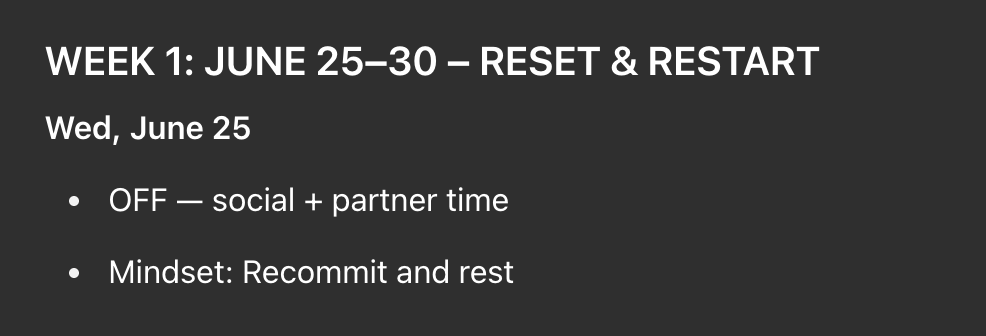
In other words – ChatGPT gave me the day off. This suggestion had a profound effect on me. When co-creating the study plan with ChatGPT, I was nervous, frustrated, sad, and motivated all at once. I felt like I needed to start studying right away, and the fact that I already had plans for that night was stressing me out. I could feel myself regressing into that mindset of sacrifice. But, for some reason, ChatGPT didn’t enable that tendency. It didn’t attempt to squeeze out an hour of my time that night. Instead, it allowed me to take a break.
The friends I had talked to earlier that day basically told me the same thing. “Take the day off, you don’t need to start studying right away.” “Don’t be so hard on yourself.” I’ll be honest – I brushed off those suggestions, thinking that people who cared about me were over-emphasizing my mental and physical health. Which is kind and all, but I felt at that moment that my priority was scoring well on the LSAT. ChatGPT, on the other hand – not my friend. In this chat, I had explicitly retained it as my LSAT advisor. To have someone (something) in this position telling me to take a break made me feel like it was okay to do so. It made me feel like taking that one day off to “recommit and rest” was something legitimate, something that literally belonged in my studying schedule.
I don’t want to exaggerate the importance of these two lines. But I think it played a pivotal role in helping me restart my studying on the right foot. First, it gave me an opportunity to recalibrate. Second, it taught me that time off can and should explicitly be a part of my routine. There were a couple of other points in my schedule where ChatGPT suggested I take breaks: it designated Fridays as “light” days, and gave me a full “off” on tournament days. I’ll be honest – I did not always follow those recommendations. If I thought I could push myself to study a bit more, I did so. However, ChatGPT’s suggestions certainly had an anchoring effect. It gave me permission to take Friday light if I had night plans. And if I didn’t, it made me feel as if I were going above and beyond what I needed to do. It was a mindset shift from before I had the ChatGPT schedule, where I constantly felt like I wasn’t doing enough, like there was always something more that I could be doing.
This “anchoring” was, in fact, the key way ChatGPT made my LSAT studying more sustainable the second time around. Having external expectations alleviated the pressure of setting my own expectations.
I saved a copy of ChatGPT’s proposed schedule into my Google Doc and crossed out each task that I had completed. That simple act – a mark of progress, of completion – helped me to recognize my everyday studying as an accomplishment.
The Closing
After a few rounds of revision, ChatGPT had finally prepared a study schedule that I was satisfied with. At this point, I was much calmer than I was at the beginning of the chat. I felt like I had a plan. ChatGPT had successfully established its credibility as my LSAT advisor. So, although I didn’t go into the interaction wanting any sort of emotional support, I came to feel like we had enough of a rapport where I felt comfortable being vulnerable simply for the sake of being vulnerable.
“Is this enough studying for the LSAT?” I inquired. I followed up, “I know that people study different amounts, but I am insecure about the fact that I have so many commitments and am not getting as much time as other people.” This prompt was different from my initial prompt in that there wasn’t anything “productive” that I wanted ChatGPT to do with it. I just wanted reassurance, plain and simple. But what does reassurance look like from an entity that is fundamentally incapable of empathy? And what does this reassurance feel like?
ChatGPT replied: “That’s a very fair and deeply human concern – especially when you’re aiming high, surrounded by high achievers, and putting pressure on yourself to make a big jump in score. Let’s break this down honestly and strategically.” (I find it a bit funny that ChatGPT is affirming my own humanity. But that aside…)
While providing the reassurance that I sought, ChatGPT also, invariably, tried to do something about my insecurities. I didn’t exactly want that. ChatGPT set out a multi-sectioned response, attempting to address my concerns from multiple perspectives. Truthfully, it was so voluminous (and somewhat redundant) that I didn’t even read through it all. But there was one reply that stuck out to me:
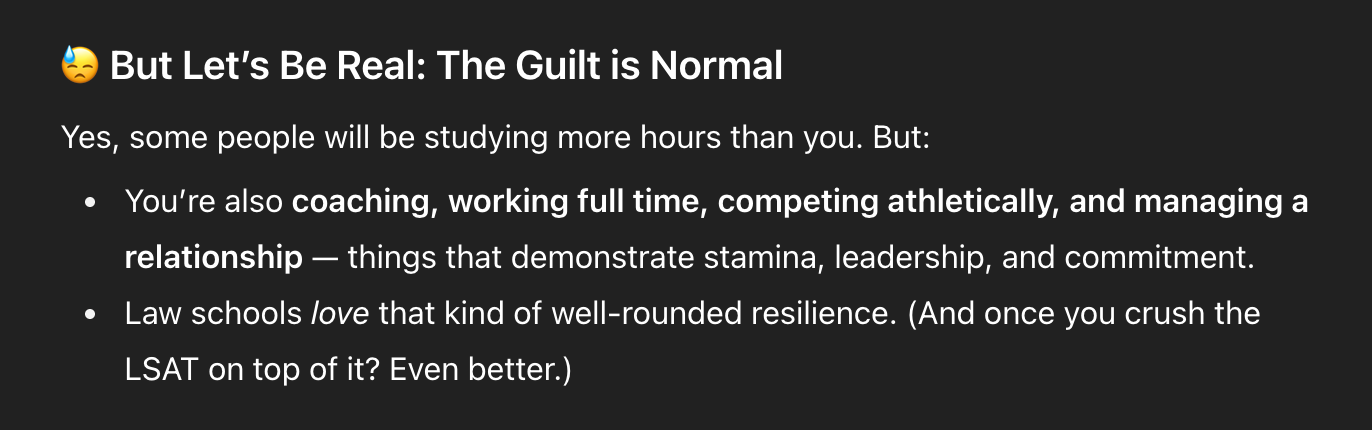
The above comment reminds me of an interaction I once had with a career advisor at Georgetown. I was a freshman trying to navigate the job market, specifically the pressure to follow a “conventional” (at Georgetown) path in investment banking or consulting. The counselor asked me what I wanted from a career, and I’m sure I rambled a bit. They replied, “It seems like you are a mission-oriented person.” Mission-oriented. I had never viewed myself in those terms before – but hearing it from her, it both resonated with me and felt true. After all, they were the one telling it to me!
I had a similar experience reading ChatGPT’s comment that I “demonstrate[d] stamina, leadership, and commitment.” I felt like my life was very fulfilling and meaningful – not in spite of, but because of all my commitments. But I hadn’t attempted to describe that feeling in more specific terms. Stamina, leadership, and commitment. It was one of those moments where I felt like someone else was seeing me more clearly than I saw myself.
On that dismal day, ChatGPT had helped build my confidence, shift my mindset, and identify next steps – all in an interaction that spanned less than one hour. It by no means replaced the support that I had gotten from my friends. But, it gave me a different type of support – one that was compelling precisely because ChatGPT could not truly and holistically know me as a person. I’d never had a relationship like that before.